CARL FRIEDRICH GAUSS: A PHENOMENAL INVENTOR SINCE THE AGE OF 10
Penulis: Assyfa Razaqi1, Azlin Fahira2, Lelen Purnama Sari3, Nasywa Adila Rahma4

Penulis
Oleh
Assyfa Razaqi1, Azlin
Fahira2, Lelen Purnama Sari3, Nasywa Adila Rahma4
(Departement Of Mathemathics and Data Science, FMIPA, Andalas University, Indonesia.)
Carl Friedrich Gauss was a mathematician who changed
the paradigm with his discovery in arithmetic series. Gauss' arithmetic
sequence became an important foundation in the development of more complex
mathematical concepts and has inspired generations of mathematicians to explore
further in this field. Gauss' genius for recognizing mathematical patterns and
his ability to quickly calculate the terms of a series became a lasting legacy
in modern mathematics. Gauss' discoveries in arithmetic series not only
influenced mathematics education, but also provided inspiration for further
mathematical developments and research.
The article on Gauss as the inventor of the arithmetic
series will be based on some relevant theoretical foundations. There are some
theoretical concepts that can be used in the article:
1. Arithmetic
Series: The article can explain the basic concept of an arithmetic series,
which is a sequence of numbers with a constant difference between each
consecutive pair of numbers. The Gauss formula, also known as the arithmetic
series sum formula, can be explained as a method to calculate the sum of a
series.
2. Gauss's
discovery: The article may discuss the life and contributions of Carl Friedrich
Gauss as a German mathematician in the 18th and 19th centuries.
3. Application
of Gauss' Formula: The article can explain the various applications of Gauss'
formula in mathematics and related sciences. For example, the formula can be
used to calculate the sum of integers from 1 to n, calculate the sum of terms
in an arithmetic pattern, or calculate the number of elements in a regular
sequence of numbers.
4. The
Importance of Arithmetic Series: The article can explain the importance of
arithmetic series in math and related sciences. Arithmetic series are used in
various fields, such as physics, economics, statistics, and computer science.
5. Further
Development of Mathematics: The article can discuss how Gauss' discovery of
arithmetic series has encouraged further development of mathematics. For
example, Gauss' formula became the basis for the development of the geometric
series sum formula and the infinite series sum formula.
GAUSS
BIOGRAPHY
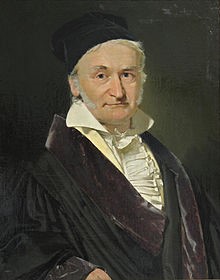
Source:
sapaviva.com
Johann Carl Friedrich
Gauss was born on April 30, 1777, in Brunswick (Braunschweig), in the County of
Brunswick-Wolfenbüttel (now part of Lower Saxony, Germany), into a family of
lower-middle social status. His father, Gebhard Dietrich Gauss (1744–1808),
worked at several jobs as a bricklayer, gardener, and treasurer of a death
benefit fund. Gauss was a mathematical genius. While still a student at the
University of Göttingen, he proposed several mathematical theorems. Gauss
completed his best works, Disquisitiones Arithmeticae and Theoria motus
corporum coelestium, as a private scholar. He later became director of the
Göttingen Observatory and professor at the university for almost half a
century, from 1807 until his death in 1855.
In addition to the
arithmetic series, Gauss also contributes to the normal distribution curve. Gauss'
contribution to probability theory is the Gaussian curve which is often
referred to as Gauss' law, which is about the normal distribution or what is
now better known as a bell-shaped curve. Errors will collect half on the left
side and half on the right side of the curve. "Incidental" errors can
be called incidents, according to Gauss, always occur with a frequency that can
be predicted in advance according to mathematics. The larger the sample, the
more accurate the prediction of errors that will occur. Scientists eventually
discovered that not only errors in certain disciplines, but almost all
phenomena follow this law.
This discovery is one
of the greatest inventions of all time. It is almost impossible to count population
data. Even if we could, it would be inefficient in time, cost, and energy. With
Gauss's discovery, the population can be estimated with accuracy that can also
be measured scientifically, with a portion of the population data taken
randomly under special conditions. A graph representing the density function of
a normal probability distribution is also known as the Normal Curve or Bell
Curve.
One needs to specify two parameters, the mean and the standard deviation. In the graph it must have a mean of zero and a standard deviation of 1. A normal distribution with a mean of zero and a standard deviation of 1 is also known as the Standard Normal Distribution. The characteristics of a normal distribution include having the parameters µ and ? which determine the location and shape of the curve. The normal distribution is a symmetric distribution. The standard deviation determines the width of the curve. The total area of the curve is 1.
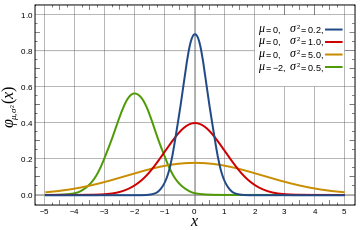
Source: wikiwand.com
There are several applications of the Gaus formula in
various fields, namely:
1. Mathematics: The Gauss formula is used to sum an arithmetic series or a geometric series. For example, to sum integers from 1 to 100, we can use the Gauss formula: where Sn is the sum of the series, n is the number of terms, a is the first term, and l is the last term.
2. Statistics:
The Gauss formula is used in the normal distribution, or Gauss distribution.
The normal distribution is a probability distribution often used in statistical
analysis. The Gauss formula is used to calculate the probability or z-score
value in a normal distribution.
During his life, Gauss
won the Copley Medal, Britain's most prestigious scientific award, given
annually by the Royal Society of London, in 1838 "for his mathematical
discoveries and research in magnetism". In 1823, the Danish Academy of
Sciences presented him with an honor for his research on angle-preserving maps.
We cannot underestimate the importance of Gauss'
discovery of the arithmetic series. This discovery has provided a strong
foundation for the development of mathematics and its applications in various
fields. Gauss is a shining example of intelligence and perseverance in
exploring the world of mathematics and making tremendous contributions to
mankind.
REFERENCES
The editor of Encyclopedia Britannica. What awards did Carl Friedrich Gauss Win?.
Accessed on November 30th, 2023.
https://www.britannica.com/question/What-awards-did-Carl-Friedrich-Gauss-win
Wight, Randal D & Gable, Philip A (2005). Gauss, Johan Carl Friedrich. Encyclopedia of
statistics in Behavioral Science. Volume 2, pp. 694-696.
Akuindo (2023). Carl
Friedrich Gauss. Wikipedia. https://id.wikipedia.org/wiki/Carl_Friedrich_Gauss
Pontes, Edel Alexandre Silva (2018). A Brief Historical Overview Of The Gaussian
Curve: From Abraham De Moivre to Johann Carl Friedrich Gauss. International
Journal of Engineering Science Invention. 4-6.