Brainrot Effect On Gen Alpha Academic Life
Penulis: Muhammad Galuh Dzikrillah
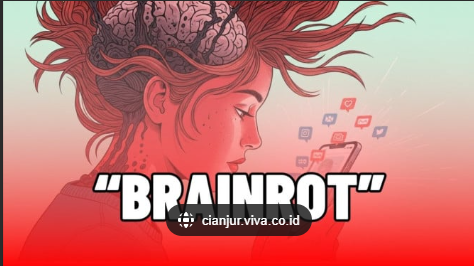
Ilustrasi
I’ll be
honest, I'm tired of pretending that “brainrot” is just harmless fun, it's kind
of annoy me too.
Like
Everywhere I scroll, someone is either ironically calling themselves
“brainrotted” or proudly sharing the latest nonsense trend like that Six Seven
or Italian Brainrot, especially that absurd Tung Tung Sahur meme. We’re
watching kids' attention spans collapse in real time, and somehow, we or they
are laughing about it.
I’m not an
expert or psychologist, I’m just someone who’s seen the internet slowly melt
people’s focus, especially kids. And while most people treat brainrot as a meme
or a joke, I can’t help but see it as something much more serious: a slow
academic and cognitive decay disguised as entertainment.
The Cult of
Absurdity
The term
brainrot started as internet slang, a self-aware way to say, “I’ve been
chronically online too long.” But somewhere along the way, the irony faded.
Trends
like six seven or the Italian brainrot edits, are loops of hyper-stimulation
bright visuals, loud sounds, no plot, no message just an AI slop of generated
image. They’re digital slot machines: each swipe gives a new “hit” of dopamine.
They don’t just grab attention, they rewire it.
The scary
part isn’t that these videos exist it’s that this is now the dominant media
language of Generation Alpha. Their humor, vocabulary, even their sense of
timing come from an algorithm’s rhythm.
The Academic
Fallout
Teachers
around the world have started noticing something off. In Indonesia, experts
from IPB University warned that students who binge short-form videos show
“drastic drops in focus and comprehension.” Globally, studies have linked
constant micro-content to weakened memory, fragmented thinking, and declining
reading ability.
Basically,
the more brainrot kids consume, the harder it becomes to learn anything that
takes effort.
When your
brain gets used to novelty every few seconds, classrooms feel unbearable,
reading a single page feels like a chore, listening to a teacher talk for five
minutes feels like an eternity, Even creativity, which should thrive in young
minds, starts to flat lining, everything becomes a remix of the same meme
template.
And
empathy? That fades too. Kids raised on chaos and absurd humor start struggling
to read emotions or tone, they usually laugh at randomness and absurdity but
y’know they freeze in real conversation.
I once saw
a video where a kid was asked who their favorite cartoon character was. The kid
just said, “YouTube?” Not a character, a platform, and that kind of breaks my
heart a little. Kids nowadays don't really watch cartoons anymore but I think
some of them do, it's just y'know they aren't familiar with it.
I mean
yeah sure, some people will say, “But there’s YouTube Kids”, as if that fixes
anything. Let’s be real, YouTube Kids isn’t exactly a safe haven for kids
either, It’s still an algorithm designed to keep kids watching, not thinking,
moreover the videos on that platform, ‘if’ the parents aren't set the algorithm
properly some content that aren't for kids to watch pass through. The colors
might be softer, the characters cuter, but the dopamine loop is the same. It
trains the same instant-reward reflex that destroys focus in the first place.
When I was
a kid, TV had boundaries. Cartoon Network literally told you, “It’s 9 p.m.,
time for bed.” There were schedules, endings, and pauses, little reminders that
the world exists outside the screen. Now? There’s no off switch, no bedtime, no
silence.
It’s
almost poetic that the generation raised on Adventure Time and Ben 10 grew up
to make Rick and Morty, Invincible, and Smiling Friends, adult cartoons born
from nostalgia and cynicism. Meanwhile, Gen Alpha doesn’t even have “favorite
characters.” They have playlists.
The “Boomer
Argument”
Whenever
someone brings this up, people love to say, “Every generation thinks the next
one’s doomed.”
Maybe, but
Boomers didn’t have a pocket-sized casino of stimuli with AI curated absurdity
running 24/7. This isn’t cranky nostalgia, this is neuroplasticity. The brain
learns whatever it repeats, and for kids today, that means endless swiping.
You can
see it in classrooms: kids can’t stay with a thought long enough to understand
it. Essays are replaced by AI summaries, reading by reaction videos, curiosity
by speed. Learning used to be about asking why, now it’s about getting to the
next clip faster and I came a across of an Instagram post with picture of a
board listing all kinds of words are banned during classroom, like one of those
brainrot phrases and words, like 6 7,Rizz, Gyat, Sigma and whatnot.
This isn’t
rebellion. It’s rewiring.
At least
back then there weren't that kind of rules set in a classroom. Back then, like
the Mannequin challenge for example, it brought people together like I've seen
a video of a whole school doing it including the teachers and staff.
So, What Now?
I don’t
think banning phones or yelling “kids these days” will help, the point isn’t to
turn back time, it’s to rebuild balance.
Teachers
could integrate digital literacy into actual lessons: teach how algorithms
work, how attention is monetized, why silence matters, parents could stop
treating gadgets as babysitters and start asking their kids what they’re
watching. Even creators they watched could reclaim absurd humor for something
smarter, chaos with meaning like how abstract painting works.
Brainrot
isn’t just an internet trend it’s a mirror. It reflects how we, as adults, have
built a world that rewards distraction and punishes focus.
But if we
can at least admit that it’s eating away at how kids learn and think, maybe we
can stop romanticizing it. Maybe it’s time we stop laughing about brainrot and
start treating it like the problem it’s quietly becoming.