EFFICIENCY OF STUDENT TRANSFER MANAGEMENTTHROUGH AN INTEGRATED SIMKES ARCHITECTURE
Penulis: Deuis Aisah
Deuis Aisah
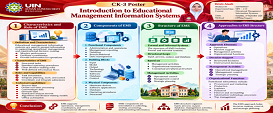
Official image template: Educational Management Information System
By Deuis Aisah
Introduction. School administration
digitalization is not merely a matter of replacing paper documents with digital
documents or providing several stand-alone applications. Service efficiency
depends greatly on how data can be entered, processed, transferred, stored, retrieved,
and used by the units that need it. In student transfer management, this issue
becomes increasingly important because the transfer process involves student
identity data, the originating and destination schools, supporting documents,
administrative status, and approvals from authorized parties. An integrated
Student Management Information System (SIMKES) architecture can provide a
framework for connecting all of these processes so that transfer services do
not operate separately.
First, an integrated SIMKES can accelerate
the flow of student transfer data. In administrative processes that are still
manual, staff often have to check files, re-enter data, send documents through
different media, and retrieve archives when needed. Such processes require time
and create opportunities for recording errors. With an integrated database,
available student data can be reused according to user authorization. Staff do
not need to repeatedly enter the same information at every stage of the
service.
Second, an integrated architecture helps
connect the units involved in student transfers. Transfer management may
involve the administrative office, student affairs, homeroom teachers, school
leaders, and other parties according to applicable procedures. If each unit
works with different data and documents, the process may be delayed because
information has to be sent repeatedly. An integrated system enables each unit
to obtain relevant information based on its access rights. Thus, the transfer
process can move from one stage to the next without having to restart data
verification from the beginning. However, system speed does not automatically
produce efficient services. The information structure, work procedures, and
division of responsibilities must be clearly designed. SIMKES needs to have an
orderly flow of data input, processing, output, and storage. Student data must
be checked for consistency before it becomes the basis for administrative
documents or decisions.
Third, an integrated SIMKES can reduce
repetitive work. Student identity data, class history, administrative
documents, and transfer-process status can essentially be managed in one
structured data source. Once the data are available and can be reused according
to authorization, staff do not need to enter the same information repeatedly.
This can save working time while reducing the possibility of multiple versions
of student data appearing across different units.
Fourth, data integration can strengthen the
control and monitoring of the student transfer process. Each stage can be
designed with a clear status, such as submission, document review, data
verification, approval, document issuance, and completion. This status information
helps staff identify which tasks have been completed and which still require
action. For school leaders, information that is available more quickly can be
used to monitor service workloads, identify points of delay, and improve
procedures.
Furthermore, an integrated SIMKES
supports information-based decision-making. At the operational level, data are
used to complete daily student transfer services. At the managerial level,
information can be used to evaluate the number of transfers, completion time, document
completeness, and process obstacles. At the strategic level, historical data
can help schools understand patterns of student movement and serve as a basis
for planning student management. Thus, transfer data do not remain merely
administrative archives but can develop into information that supports school
management.
Author Biography
Deuis
Aisah was born in Bandung on October 22, 1983. She is the third of four
siblings. She resides in Saparako, Majalaya District. Email:
[email protected]. Education: SDN Talun I, graduated in 1995; SMPN I Ibun,
graduated in 1998; SMA Pasundan Majalaya, graduated in 2001; Bachelor's degree
(S1) from UPI Bandung, majoring in Regional Language Education, graduated in
2006; Bachelor's degree (S1) from Universitas Terbuka, majoring in Primary
School Teacher Education (PGSD), graduated in 2015. She is currently pursuing a
Master's degree (S2) in the Islamic Education Management Study Program at UIN
Sunan Gunung Djati Bandung. Her motivation for pursuing MPI is to broaden her
insight and knowledge and to strengthen her management competencies as a
foundation and resource for managing schools in general and herself in
particular. Motto: “Besides understanding, one must also be
sensitive; Sharpen, Love, Nurture.”
This
article is adapted from the teaching module for the Educational Management
Information Systems course.
Source: Rusdiana, Sistem Informasi Manajemen
Pendidikan, Digital Library UIN Sunan Gunung Djati Bandung.
https://digilib.uinsgd.ac.id/96098/